Multi-rater calibration to the mean human response
TwinTrack: Post-hoc Multi-Rater Calibration for Medical Image Segmentation
(Kirscher et al., MIDL 2026, short paper) motivates calibrating tumor probabilities
against the mean human response (MHR): the fraction of annotators assigning
each class to a voxel. With two positive votes out of five, the binary target is
[0.6, 0.4]. MHR describes the available raters, not a unique anatomical truth
or a guaranteed response from another rater population.
Fiducio provides a binary isotonic map inspired by that approach and extends its nine parametric calibrators to accept class distributions. This is not a claim that TwinTrack evaluated all nine methods.
Data contract
- Predictions:
(B, C, *spatial), or a voxel table(N, C). - Hard targets:
(B, *spatial)integer labels, withignore_indexas usual. - Soft targets:
(B, C, *spatial)floating distributions, finite, in[0, 1]and summing to 1 along classes at valid positions. The sum tolerance matches probability inputs (1e-3, widened for half precision); inputs are not silently normalized. Binary soft targets need both channels. - Rater annotations:
(B, R, *spatial)integer labels with rater axis 1. - Masks:
(B, *spatial),Truefor valid voxels. Use masks for soft targets;ignore_indexonly removes hard labels or missing individual votes.
from fiducio import BinaryIsotonicCalibration, mean_human_response

# annotations: (B, R, *spatial), missing annotations encoded as -100
mhr, annotated = mean_human_response(annotations, num_classes=2)
cal = BinaryIsotonicCalibration(input_type="probs", device="cpu")
cal.fit(probabilities, mhr, mask=annotated)
calibrated = cal.transform(test_probabilities)
mean_human_response returns float32 class proportions and a boolean mask on the
input device (NumPy inputs use CPU). Missing votes are excluded from the
denominator; voxels with no annotation contain zero mass and must be masked
out. An empty rater axis yields zero mass and an all-false mask, and fitting on
no valid voxels raises an error. There is no one-hot tensor per rater.
Each valid voxel contributes equally even when annotation counts differ, so MHR fitting averages each voxel's available-rater loss rather than weighting more annotated voxels more. Missingness can still bias the target. There is no implicit rater-confidence or patient weighting.
Parametric fits and validation
TemperatureScaling, ETS, vector/matrix/Dirichlet scaling and all three
class-conditional methods accept these distributions through the existing fit
API and minimize cross-entropy against MHR. With a fixed number of raters this
equals the mean cross-entropy against the individual labels, including its
gradient. Exact one-hot targets use the hard-label fitting kernel, so their
optimizer path matches integer labels; genuinely soft targets retain all classes.
ETS stage 2 computes cross-entropy after forming the mixture, using every class probability for soft targets. It needs more memory than its hard-label true-class-only path. Conditional experts still route voxels by the original predicted class, never by the MHR.
Training and early-stopping validation can independently use hard or soft targets; validation must be separate from calibration and test cases, and Adam's existing early-stopping rules apply. Isotonic regression does not use gradient optimization or early stopping and rejects validation data.
For example, use MHR on both the calibration and validation splits:
from fiducio import TemperatureScaling

# p_* and a_* are probabilities and rater annotations from separate case splits.
q_cal, mask_cal = mean_human_response(a_cal, num_classes=2)
q_val, mask_val = mean_human_response(a_val, num_classes=2)
cal = TemperatureScaling(input_type="probs", device="cpu", patience=15)
cal.fit(
    p_cal,
    q_cal,
    mask=mask_cal,
    val_predictions=p_val,
    val_targets=q_val,
    val_mask=mask_val,
)
calibrated_test = cal.transform(p_test)
Binary isotonic fitting
BinaryIsotonicCalibration(n_bins=250) learns a nondecreasing map for class 1:
- Sort valid positive-class probabilities, grouping exact ties.
- Make at most
n_binsapproximately equal-mass bins. Cut ranks are rounded up to the end of a tie group, so equal scores never receive different mappings. - Fit bin target means with PAVA weighted by voxel counts.
- Interpolate linearly between the fitted bin centers; outside the learned score range, return the nearest endpoint value.
One distinct score gives a constant map. Plateaus are allowed; this preserves
nondecreasing voxel-score order and can change a segmentation thresholded at 0.5.
It does not promise to preserve the per-voxel class argmax. Only C=2 is
supported; there is no independent multiclass isotonic renormalization.
Coordinates, sums and PAVA use float64; public probabilities use float32. Exact
input zeros are retained as fitting data and do not pin the map at 0. The learned
outputs are returned without clipping when they are exactly 0 or 1; an input
score of 0 or 1 is still calibrated and need not remain 0 or 1. Outside the
learned score range, a score maps to the nearest fitted endpoint value.
decision_function returns log-probabilities and legitimately contains -inf
at zero probabilities. Saved coordinates remain finite and are validated for
monotonicity when loaded. Existing parametric checkpoints remain readable.
The binning, tie handling and interpolation above are explicit Fiducio conventions. The paper specifies equal-mass fitting bins without fixing a bin count; Fiducio defaults to 250. Identity with TwinTrack's original code has not been verified, and binned fitting need not equal an unbinned isotonic optimum on all individual voxels.
Metrics: two different ECEs
Use class_index=1 on reliability_curve, expected_calibration_error,
unweighted_calibration_error (also average_calibration_error) and
plots.reliability_diagram for positive-class probability versus target
proportion. Without class_index, the top-1 definition remains the default:
observed agreement is q[argmax(p)] for a soft target.
ECE against MHR bins predictions, then compares average probability with
average MHR. Mean per-rater ECE computes an ECE against each rater first,
then averages the results. They differ because absolute values precede the
rater mean. One voxel predicted at 0.5 with votes [0, 1] has MHR-ECE 0 but
mean per-rater ECE 0.5. The plot annotates ECE against its supplied targets; it
does not infer mean per-rater ECE from an MHR tensor.
TwinTrack's appendices B and D specify 50 uniform evaluation bins and ECE
computed per rater then averaged. Retain individual annotations for that metric.
Use each rater's valid mask, average evaluable raters equally, report their
number and missing votes, and exclude undefined ECEs explicitly rather than
replacing them with zero; different masks imply different evaluated
populations. If no rater is evaluable, report NaN.
ReliabilityCurve.bin_accuracy stores the observed proportion in class mode;
empty bins retain zero statistics and ACE uses only nonempty bins. Empty
evaluated populations return NaN metrics.
NLL is -mean(sum_c q_c log(p_c)), with the existing 1e-12 floor.
Brier-MHR is mean(sum_c (p_c - q_c)^2). Mean per-rater Brier adds
mean(1 - sum_c q_c^2) on the same voxel population. Binary two-channel Brier
is twice the squared error on the positive channel. Neither is the TwinTrack
volume CRPS, which needs the original volume-evaluation protocol.
Reproducible use
Run uv run python examples/multi_rater_calibration.py from the repository. It
creates synthetic independent case splits, compares no calibration, single-rater
calibration and MHR calibration for TS and isotonic regression, and writes
outputs/multi_rater_reliability.png. It needs the plots extra and does not
download patient data. It reports metrics pooled across test voxels, not averaged
per case. The diagram is against MHR; the separately reported mean-rater ECE
uses individual votes.
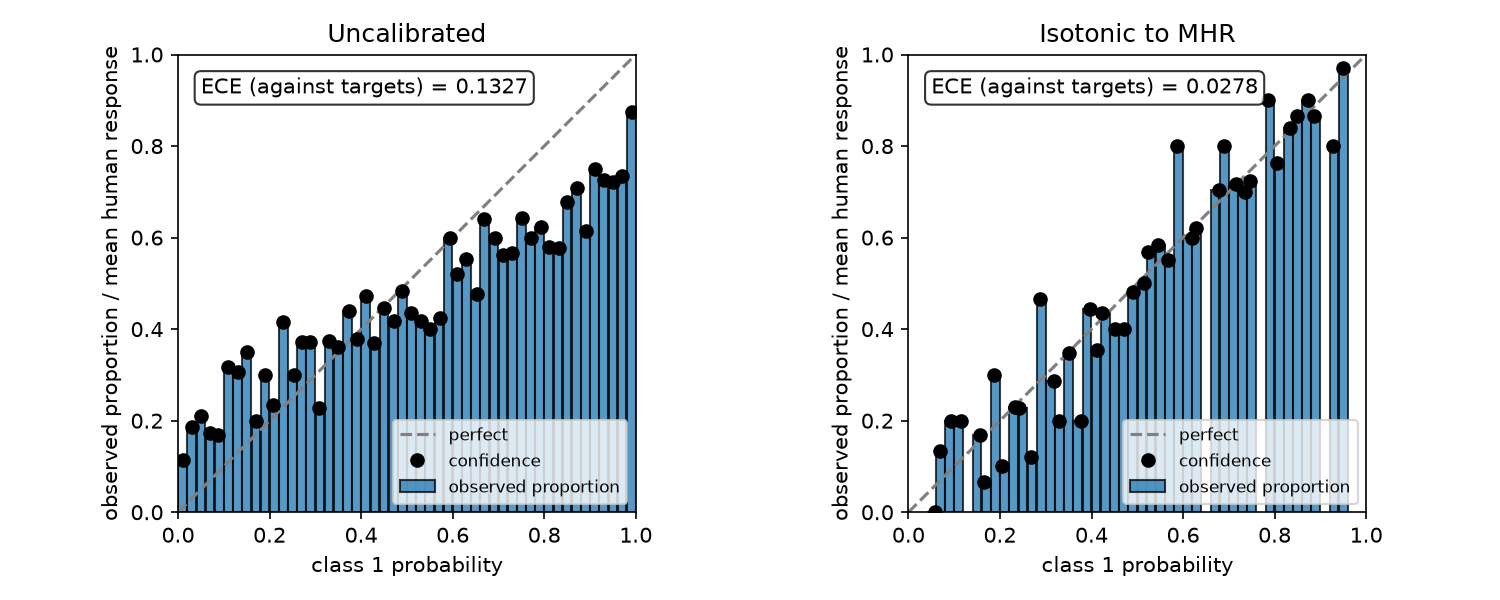
Class 1 probabilities versus MHR on held-out synthetic test cases, using 50 uniform evaluation bins; the annotated ECE is against MHR, not mean-rater ECE. Regenerate it with the script above; see Plotting for how to read the diagram.
For real data, split by patient before selecting voxels, and fix the ensemble pooling, class merging and ROI before fitting. Record splits, raters, versions, mask policy and any sampling seed with the checkpoint. Sampling to balance foreground and background changes the target voxel distribution, so calibration on that sample does not guarantee calibration on complete volumes. All fits remain in memory, including isotonic sorting (O(N log N) time, O(N) memory); a sampled voxel table must therefore be prepared and described explicitly for large data.
Do not select the calibrator, fitting bins or ROI on the test set. MHR fitting need not improve every test metric: isotonic squared error, parametric cross-entropy and ECE are different objectives. Fiducio does not ship the nnU-Net segmenter, volume CRPS, vascular metrics or a reproduction of CURVAS results.